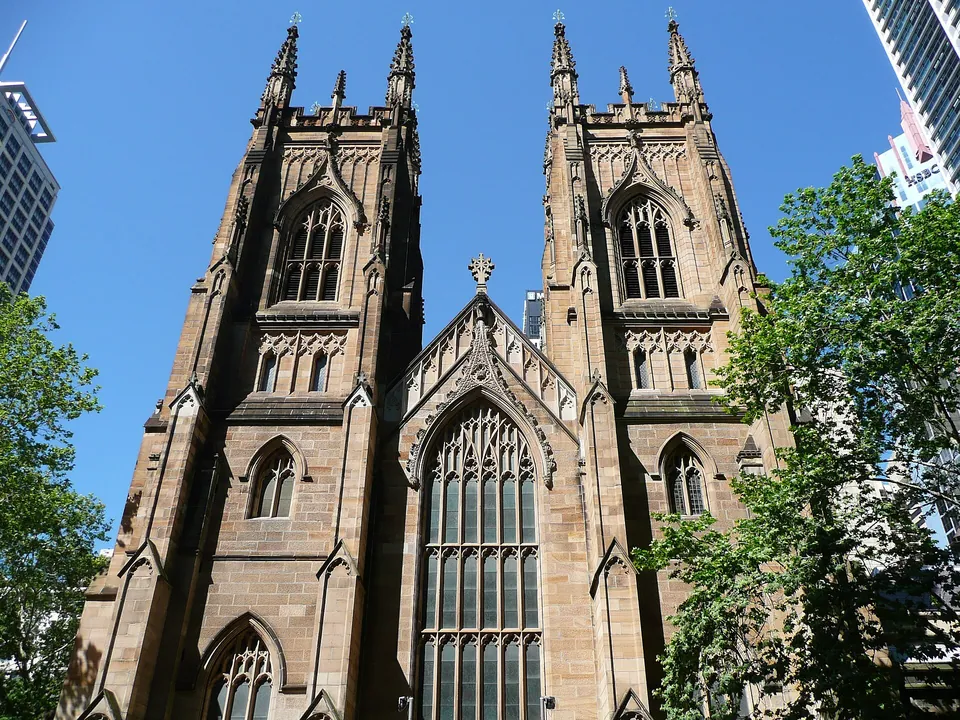
St Andrew’s Cathedral
George Street at Sydney Square
Edmund Blacket, on foundations by James Hume. 1837 to 1868, towers 1874. Victorian and Federation, Sydney Sandstone.
- Material
- Sydney sandstone throughout, slate roof, hammerbeam timber roof
- Status
- State Heritage Register, 2004. A working Anglican cathedral
This is Sydney’s third attempt at a cathedral on one block. Governor Macquarie laid a stone in 1819 for a vast church planned with Francis Greenway, but Commissioner Bigge’s inquiry killed the scheme. A second stone in 1837 started a modest Gothic church by James Hume, whose walls had reached about five metres when drought and depression stopped work in 1842.
That year Edmund Blacket arrived in the colony, carrying a letter from the Archbishop of Canterbury. Appointed in 1846, he faced an awkward brief: make something imposing on foundations the size of a large English parish church, with Hume’s window tracery already in place. He chose Perpendicular Gothic and twin western towers, with a front loosely based on York Minster. It was consecrated on St Andrew’s Day 1868.
It has since been caught up in arguments about what a cathedral is for. In 1887 the synod objected to a Crucifixion in the alabaster reredos as idolatrous, and the objectors paid for a Transfiguration to replace it. Trams on George Street drowned out services, so in 1941 the whole interior was turned around to face the other way. A restoration in 1999 to 2000 turned it back, and the masons added a joke of their own, carving a likeness of the Rev. Boak Jobbins into the roof stonework.
The stone
The stone has been a worry almost from the start. Decay and water damage had set in by the 1890s. Roofs, pinnacles and the south transept were rebuilt between 1942 and 1960, about $1.2 million went on a restoration begun in 1968, and the stonework still needs a long-term programme of repair. The stone is from Pyrmont.
Sources
- St Andrew's Cathedral, Sydney, Wikipedia
- St Andrew's Cathedral, Dictionary of Sydney (archived by State Library of NSW)
- Industry > Sandstone, Pyrmont History Group