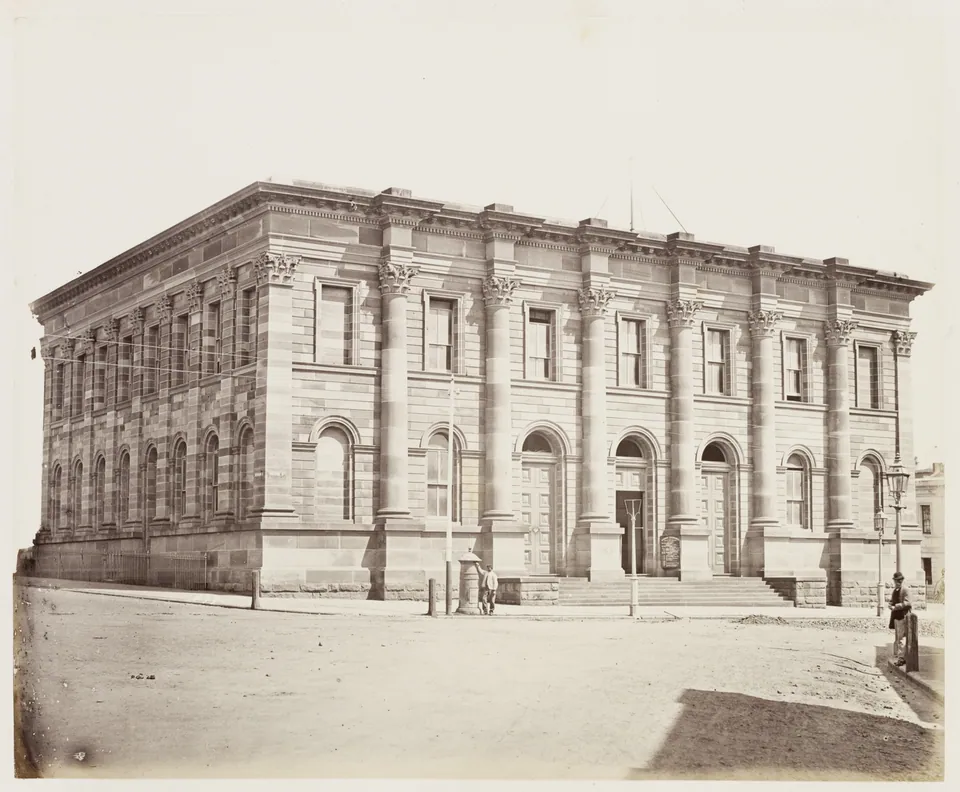
Royal Exchange
Bridge Street, between Pitt and Gresham Streets, Sydney
John Frederick Hilly; two storeys added by Arthur F. Pritchard. 25 August 1853 to December 1857; two storeys added 1900 to 1901. Victorian and Federation, Sydney Sandstone.
- Size
- About 28 metres across Bridge Street and 32 metres deep. Hilly’s cornice stood 15 metres above the street; the storeys of 1900 raised the front to about 25 metres, with Commerce rising to about 34 metres
- Material
- Sydney sandstone on a rock-faced basement; the storeys of 1900 mainly terracotta and steel; James White’s statue of Commerce in hammered copper
- Status
- Demolished in 1964. The office tower at 56 Pitt Street, which kept the name Royal Exchange, stands on the site, with White’s Commerce outside it on Pitt Street
In 1851 a group of Sydney merchants formed the Sydney Exchange Company to give the city’s traders a place to meet, and the Governor, Sir Charles FitzRoy, granted it land on Bridge Street, between Pitt and Gresham Streets, on condition that it be used only for an exchange. John Frederick Hilly won the competition for the design. He took the Paris Bourse as his model, with a great covered hall at its heart in place of the open courts of the older exchanges of Europe. FitzRoy laid the foundation stone on 25 August 1853 before a crowd of about 4,000. The gold rush in Victoria drew away the masons and slowed the work, and the next Governor, Sir William Denison, opened the Exchange on 30 December 1857. The colony’s electric telegraph opened its office in the building on the opening day. A grand ball followed that evening.
Hilly took his details from the Pantheon in Rome. The front to Bridge Street, 92 feet wide, stood on a basement of rock-faced stone, its blocks left as they came from the quarry, and on a stylobate 6 feet 6 inches high. On this rose six Corinthian columns 30 feet high and 3 feet 2 inches across, with pilasters at the angles and nine more down each side street, carrying an entablature 8 feet deep that ran right round the building. A flight of six steps 30 feet long climbed to three arched entrances with doors of panelled cedar, set between arched windows, and the windows above were glazed with plate glass from Europe. Inside, the great hall ran 82 feet from Pitt Street to Gresham Street, 40 feet wide and 20 feet high, its panelled ceiling carried on twelve fluted Ionic columns, with the merchants’ reading room behind it and the Chamber of Commerce upstairs. Hilly drew a balustrade and figures of Agriculture, Peace, Plenty and Commerce above the columns; the front was finished instead with a plain blocking course.
The Exchange became the meeting place of Sydney’s commerce. The Chamber of Commerce made its home there, wool was auctioned in the building from 1864, and Sydney’s sharebrokers began meeting there in 1871, the beginnings of the Sydney Stock Exchange. In 1880 the first telephone system in New South Wales was set up there, joining the Exchange to the woolsheds at Darling Harbour.
By the end of the century the wool trade had outgrown the building, and the company’s architect, Arthur F. Pritchard, added two storeys. The chairman, George Judah Cohen, laid their corner-stone on the roof on 9 March 1900, and McLeod Brothers built them for about £23,000. To keep them light the new storeys were built mainly of terracotta and steel, with the steel girders cased in terracotta against fire. Pritchard carried Hilly’s columns up as pilasters, fluted in the middle of the front, lit the new floors with round-headed windows below and balconied windows above, and crowned the middle three bays with a pediment. Inside he lengthened the great hall, put hydraulic lifts behind new entrances in Pitt and Gresham Streets, and made a wool saleroom 33 feet high under a coved and embossed metal ceiling, with tiered seats for nearly 200 buyers and a public gallery. It opened on 28 January 1901.
On 31 December 1900, the eve of Federation, James White’s Commerce was unveiled on the pediment: a figure 15 feet 6 inches high, standing on a globe with a laurel branch in one hand and Mercury’s staff in the other and wings on her head, with an anchor, a ram’s head and fleece, a sheaf of wheat and miners’ tools about the globe. White made her of hammered sheet copper, the first statue made that way in Australia. In May 1901 the building became the Royal Exchange. In the 1960s developers bought into the Sydney Exchange Company, and a new Act of 1964 changed the terms of the original grant. The last wool sale in the building was held on 9 July 1964, after a century of wool selling there, and the Exchange was demolished that year for the office tower at 56 Pitt Street, which kept its name. White’s Commerce stands outside it on Pitt Street.
The stone
Hilly built the Exchange of Sydney sandstone, colonial freestone of an even pale colour, in walls more than 2 feet thick, on a basement of rock-faced blocks whose walls were 3 feet thick. The kerb of the footway round it was red granite from Gabo Island, laid in 1857. The two storeys of 1900 were built mainly of terracotta and steel to keep them light.
Sources
- Opening of the Sydney Exchange, Empire (Sydney), 30 December 1857, p. 4 (Trove)
- Summary for per mail steamer Columbian: Opening of the Sydney Exchange, Empire (Sydney), 9 January 1858, p. 5 (Trove)
- The New Sydney Exchange, Illustrated Sydney News, 26 November 1853, p. 1 (Trove)
- Public works and city improvements, Sydney Morning Herald, 15 May 1857, p. 6 (Trove)
- Public improvements, Sydney Morning Herald, 22 January 1857, p. 3 (Trove)
- Royal Exchange, Dictionary of Sydney
- History of the Royal Exchange, The Royal Exchange of Sydney (brochure, 2021)
- Enlargement of the Sydney Stock Exchange, Sydney Mail, 28 October 1899, p. 1057 (Trove)
- The Sydney Exchange Company, Sydney Morning Herald, 10 March 1900, p. 5 (Trove)
- The Statue of ‘Commerce’ for Sydney Exchange, Australian Town and Country Journal, 17 November 1900, p. 26 (Trove)
- The Sydney Exchange: unveiling the statue of Commerce, Daily Telegraph (Sydney), 1 January 1901, p. 6 (Trove)
- New Wool Exchange, Sydney Morning Herald, 29 January 1901, p. 7 (Trove)
- Merchants’ Exchange, Australian Star, 21 March 1901, p. 7 (Trove)
- The Royal Exchange of Sydney: ‘On ’Change’, Sydney Mail, 17 August 1901, p. 404 (Trove)
- … and historic sale room closes forever, Canberra Times, 10 July 1964, p. 17 (Trove)
- Quick look, Telegraph (Brisbane), 23 April 1964, p. 14 (Trove)
- 1964: The Royal Exchange Building closes its doors, Fab Sydney Flashbacks (Fabian Amuso), 29 November 2021
- Bridge Street looking south west from Macquarie Place Sydney, 1890 (SRC3205), City of Sydney Archives