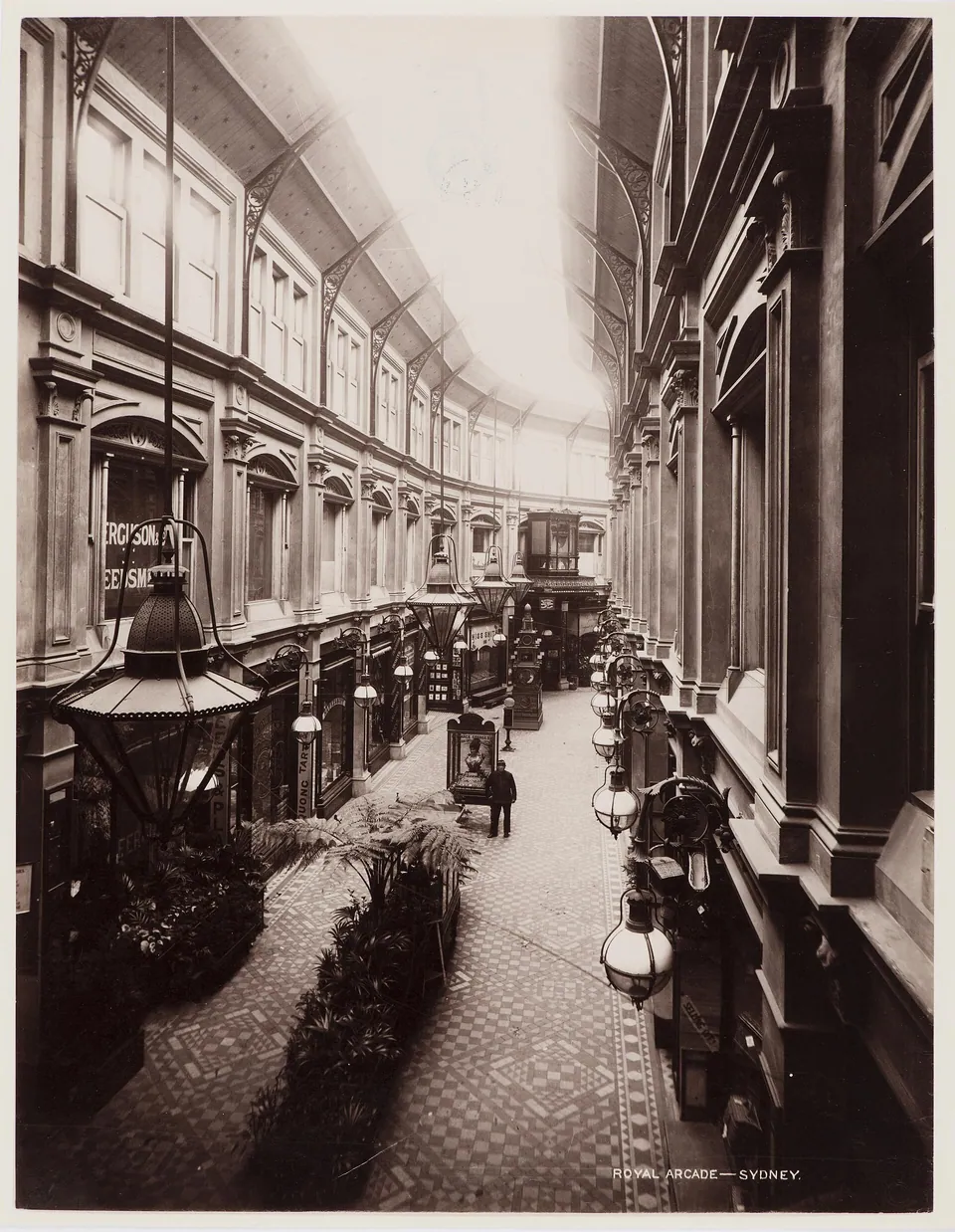
Royal Arcade
George Street to Pitt Street, opposite the Queen Victoria Building, Sydney
Thomas Rowe. 1881 to 1882. Victorian and Federation.
- Size
- 296 feet (90 metres) from George Street to Pitt Street, with 31 shops on the ground floor and 36 offices above
- Material
- Plate-glass shopfronts between piers inset with mirror glass, a lofty clerestory under a glass roof, and a floor of encaustic tiles
- Status
- Demolished in 1969, with Tattersall’s Hotel next door. The Hilton Sydney, rebuilt in 2005, stands on the site
The brothers J. W., George and F. Withers built the Royal Arcade to Thomas Rowe’s design of 1881. It ran 296 feet through the block, from George Street, opposite the entrance to the markets, to Pitt Street close to the School of Arts. On Friday 10 November 1882 the proprietors gave a banquet in the arcade itself for several hundred of the city’s leading citizens, with the tables laid in a double line down nearly its whole length. At noon the next day the Premier, Sir Henry Parkes, opened it, and for the rest of the day the arcade was thronged.
Rowe gave it a free treatment of Italian. Each bay of the arcade was marked by a bold panelled pier with a base, a capital and angle leaves, and the lower panel of every pier was filled with mirror glass. The shop windows were large sheets of plate glass reaching to within a foot of the floor, framed by slender columns and topped by transoms with cast-iron gratings for ventilation. Above them rose a lofty clerestory with three windows to each bay, arranged to air the arcade without a draught, and over it all a glass roof on iron trusses with ornamental cast-iron brackets. The floor was laid with encaustic tiles in patterns, and gas lamps on Sugg’s system lit it, the shops under large opal globes on wrought-iron brackets.
The 31 shops on the ground floor were each about 12 feet 6 inches wide and 20 feet deep. On the first floor 36 offices opened off corridors running the length of the arcade behind them, lit by skylights, and at the George Street end the second floor held a photographic gallery 50 feet by 14, with its dark, printing, toning and solar rooms. In the 1880s the portrait photographers Charlemont & Co. worked from the arcade.
The George Street front had three shops, the entrance to the arcade and a door at each side to the offices above. On Pitt Street two shops flanked an entrance 14 feet wide, with stairs to the offices at each end of the front. Over that entrance the name Royal Arcade ran across the front beneath three arched windows, and the parapet rose to a pediment inscribed “Erected 1882 by Withers Brothers”, crowned by a bust.
In 1969 the arcade was demolished with its neighbour, Tattersall’s Hotel, and the Sydney Hilton, designed by Kolos & Bryant, was built on the site. The hotel was largely rebuilt to designs by Johnson Pilton Walker and reopened in 2005.
Sources
- Sydney Improvements: The Royal Arcade, Illustrated Sydney News, 25 November 1882, p. 8 (Trove)
- Royal Arcade, Dictionary of Sydney
- Hilton Hotel, Dictionary of Sydney
- Photographs - New South Wales, 1879 - ca. 1892 / N.S.W. Government Printer (the Royal Arcade), State Library of New South Wales, PXD 855
- The Royal Arcade, Sydney, circa 1892, Art Gallery of New South Wales, 207.1989
- George Withers, Sydney's Aldermen (City of Sydney)
- Sydney Hilton, ArchitectureAU (Architecture Australia)
- Watson or Playfair family baby in a basket, ca. 1885 / photographer Charlemont & Co., Royal Arcade, Sydney, State Library of New South Wales (Wikimedia Commons)
- Thomas Rowe, architectural drawings (biographical note), State Library of New South Wales, archival catalogue (after J. M. Freeland, Australian Dictionary of Biography)
