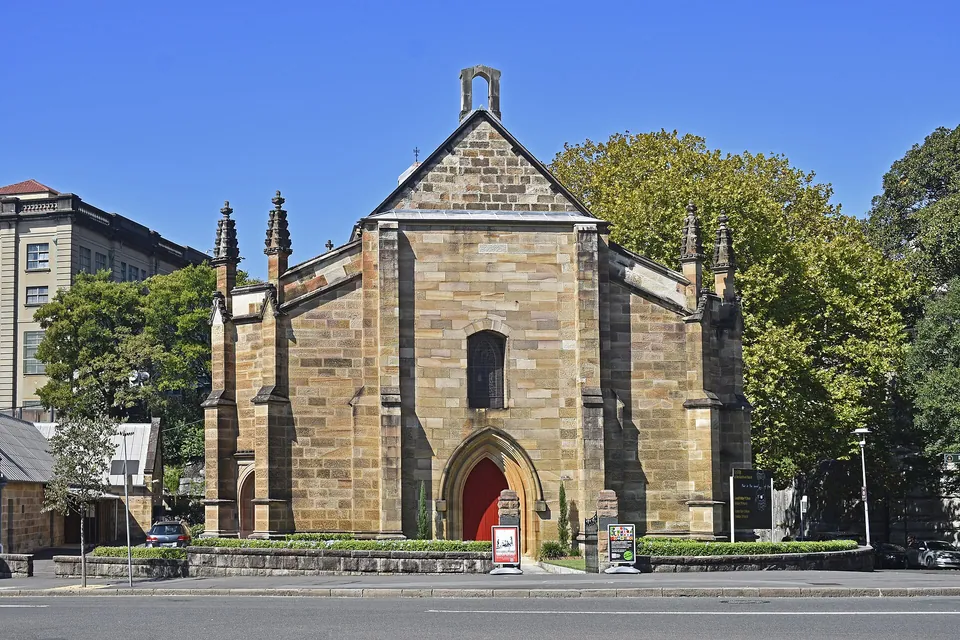
Garrison Church
Argyle Place, Millers Point
Henry Ginn; later work by Edmund Blacket. 1840 to 1846, completed 1878. Colonial, Sydney Sandstone.
- Size
- About 17 m wide, walls about 14 m
- Material
- Locally quarried sandstone, slate roof, stone tracery
- Status
- State Heritage Register, 1999. A working Anglican church
Its proper name is Holy Trinity, and military insignia were dedicated here in 1952.
It’s one of five surviving churches built with government money under the Church Act of 1836. Bishop Broughton laid the stone in June 1840. The depression of the 1840s slowed it down, services began in the unfinished building in 1844, and it wasn’t consecrated until 2000. Edmund Blacket added a pulpit and vestry and drew a tower and spire. The tower was never built, even after a split vote in its favour in 1887, and the large buttresses prepared for it have since been reduced.
Tradition says the human-head corbels on the east window, bought for £100 in 1860, are Queen Victoria and Prince Albert. In 1855 its masons were among the first in Sydney to win the eight-hour day.
The stone
The mason was George Paton, who also built the Hero of Waterloo down the road. The stone was quarried locally. The honey and brown blocks of the walls are a good place to see the natural variation in the stone.
Sources
- Garrison Church, Sydney, Wikipedia
- Hero of Waterloo Hotel, Dictionary of Sydney (archived by State Library of NSW)
- Eight-hour day page, quoting historian Rowan Cahill, Union Songs