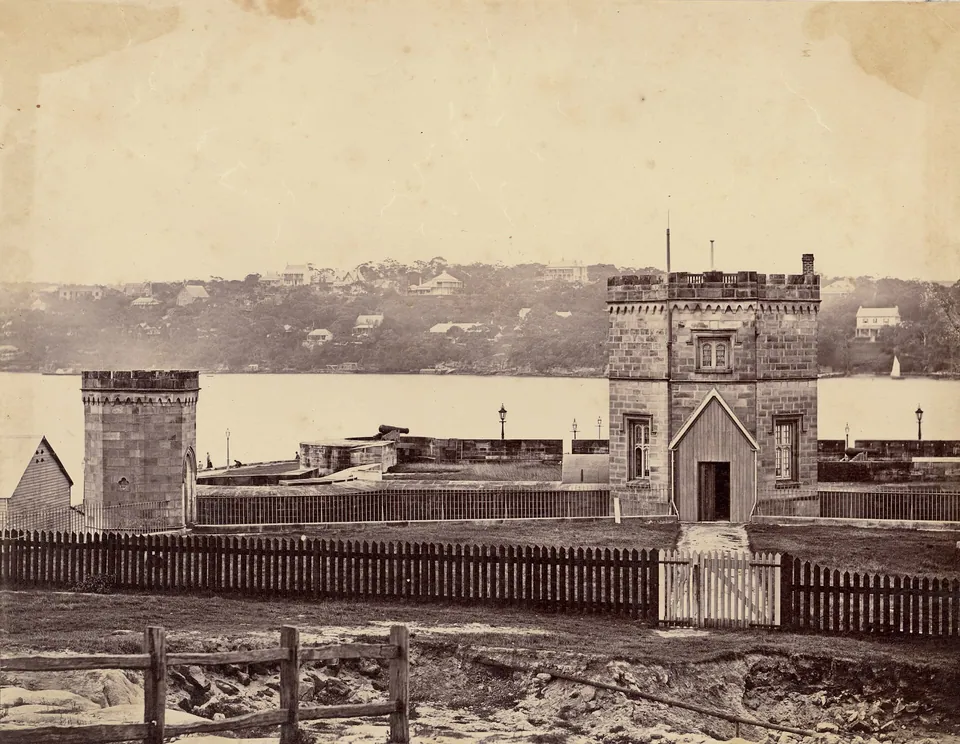
Fort Macquarie
Bennelong Point, Sydney
Francis Greenway. 1817 to 1821. Colonial, Sydney Sandstone.
- Size
- A square of about 40 metres inside the parapets, about 55 metres over its four round bastions; the gun platform 6.7 metres above high water; a two-storey tower about 27 metres round
- Material
- Sandstone quarried in the Governor’s Domain and cut and laid by convicts
- Guns
- Fifteen when built: ten 24-pounders and five 6-pounders
- Status
- Demolished from February 1901 for the Fort Macquarie tram depot, which was itself demolished in 1958. The Sydney Opera House stands on the site, and remains of the fort lie beneath its forecourt
Bennelong Point is Tubowgule to the Gadigal people. In 1790 Governor Phillip built a brick hut here for Woollarawarre Bennelong, and the point took his name. It was fortified almost from the start: Lieutenant William Dawes raised a small redoubt with two brass six-pounders on the east side of Sydney Cove in 1788, and in 1798 a half-moon battery at the end of the point mounted guns from the armed tender Supply.
In July 1817 Governor Macquarie asked the convict architect Francis Greenway to “draw out a Ground Plan and Elevation of a neat handsome Fort” for the point. Macquarie wanted it to stop vessels being “cut out of the Cove at Night”; Greenway saw it guarding the harbour against an enemy as well. Macquarie laid the foundation stone on 17 December 1817, convicts built it, and it was finished in 1821. It stood on a reef at the very end of the point, cut off from the mainland by a narrow channel of salt water and entered by a drawbridge.
Greenway made it a small castle in the Picturesque Gothic manner. It was a square of 130 feet inside the parapets, with a round bastion at each angle, and three of its faces stood in the harbour, the sea washing the foot of the ramparts at high water. The gun platform ran 22 feet above high water. There were fifteen guns, ten 24-pounders and five 6-pounders: a 24-pounder on a traversing carriage in each bastion, firing over the parapet, and one sea face pierced for three guns. In the middle of the land face rose a castellated two-storey tower, 90 feet round, with a frieze of small pointed arches under its battlements, and the fort was entered through it. Its basement held a magazine for 350 barrels of powder, and its rooms were the guard room and store, where an officer and twelve gunners lived.
By 1825 the 3rd Regiment of Foot, the Buffs, held the fort. Its guns were never fired at an enemy, but they fired salutes for the accession of Queen Victoria, the fall of Sebastopol and the arrival of governors, and every governor since Macquarie landed at the point. The Crimean War brought more guns in 1854, and under Governor Denison a barbette for five guns was built out on the landward side. In 1861 an esplanade was reclaimed around the walls and opened to the public. In March 1871, during the Franco-Prussian War, five 42-pounders were added and fifty gunners manned the fort for the last time; from then on the Naval Brigade trained here. Standing on the point that turns the harbour one way into Sydney Cove and the other into Farm Cove, it stood out in every view of the harbour looking west, and during the centenary celebrations of 1888 crowds filled the ground before it to watch fireworks burst over the water.
Harbour works took away the western walls in 1890. In 1901 the Minister for Works decided to clear the point for a tram depot, and demolition began that February. The red-brick Fort Macquarie tram depot that replaced it in 1902 was given towers and battlements in memory of the fort. It closed in 1955 and was demolished in 1958 to make way for the Sydney Opera House.
The stone
The stone was hewn by convicts from the rocks of the Governor’s Domain, close by, and its masonry was much admired. The walls were built of great blocks so closely jointed that they were almost solid when they were taken down in 1901. Some of that stonework is still in the ground: remains of the tower and of Denison’s barbette lie under the forecourt and covered concourse of the Opera House, and when they were uncovered in 2022 they were recorded and kept in place beneath the new escalators.
Sources
- Bennilong Point and Fort Macquarie (paper read to the Australian Historical Society by J. P. McGuanne, 19 February 1901), Sydney Morning Herald, 23 February 1901, p. 11 (Trove)
- Vanishing Sydney: Fort Macquarie, Sydney Mail and New South Wales Advertiser, 2 March 1901, p. 539 (Trove)
- Fort Macquarie car-sheds: a new tramway depot, Sydney Morning Herald, 22 September 1902, p. 5 (Trove)
- Fort Macquarie: old harbour defences (C. P. Dolan), Sydney Morning Herald, 26 January 1935, p. 10 (Trove)
- The scene from Fort Macquarie, Sydney Morning Herald, 2 February 1888, p. 5 (Trove)
- Before the Fort, Sydney Opera House, on Google Arts & Culture
- Tubowgule, Sydney Opera House
- Sydney’s forgotten fort, GML Heritage
- Sydney Opera House: Utzon Escalators, GML Heritage
- Sydney Opera House Box Office Accessibility Project, GML Heritage
- Fort Macquarie, Dictionary of Sydney
- Plan of Site of Fort Macquarie (Appendix A; photo-lithographed at the Government Printing Office, Sydney, about 1883), National Library of Australia, MAP F 132/2
- Fort Macquarie and the North Shore, about 1885 (attributed to Joseph Bischoff), and Exterior of Fort Macquarie, about 1870, State Library of New South Wales, SPF/121 and DL PX 163 (on Wikimedia Commons)
- Fort Macquarie Tram Depot, Wikipedia
