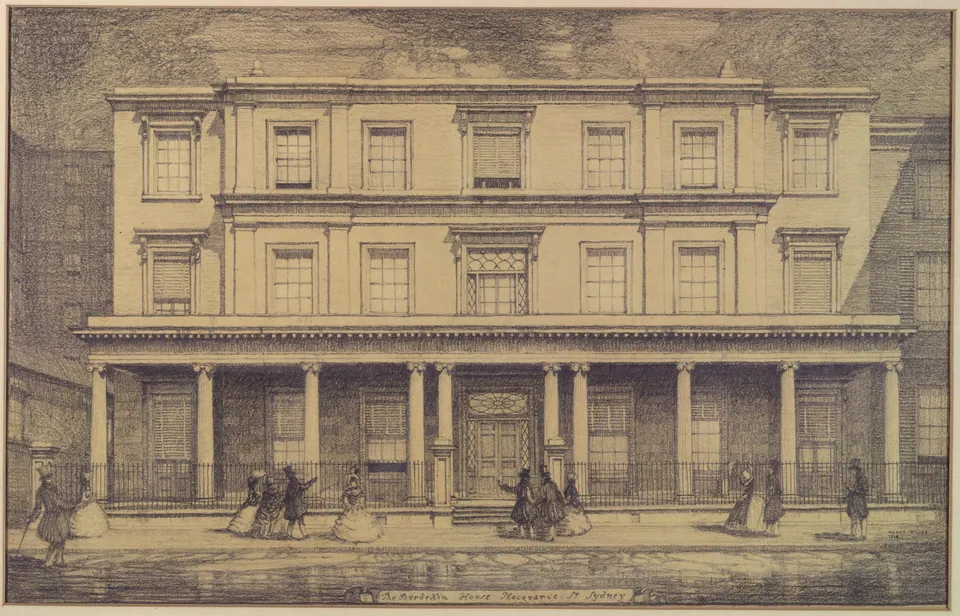
Burdekin House
197 Macquarie Street, Sydney
Built under the supervision of James Hume. 1841. Colonial.
- Size
- Three storeys over a basement, about 21 m (70 feet) across the ground floor in seven bays and about 12 m to the top of the cornice
- Material
- Squared sandstone behind the verandah and smooth render above, ten fluted timber Ionic columns, cedar joinery and staircase
- Status
- Demolished in August 1933. St Stephen’s Uniting Church, opened as St Stephen’s Presbyterian Church in 1935, stands on the site, and a brass plaque in the pavement outside recalls the house
Thomas Burdekin, an ironmonger from Sheffield, came to Sydney in 1828 to open a branch of the family firm, Burdekin & Hawley, and became a wealthy merchant and landholder. In 1841 he built this house on Macquarie Street, across the road from the Legislative Council, with James Hume supervising the work. When it was nearly finished in August 1841 the Sydney Herald called it “the most handsome house in Sydney”. The architectural historian Morton Herman judged it superbly built and beautifully finished, “the finest building in the Regency style in New South Wales”.
The ground floor ran 70 feet across seven bays behind a verandah of ten fluted timber Ionic columns, paired either side of the door, their angular capitals turning the volutes out to the corners. Behind them the wall was squared sandstone, with tall sash windows over panelled aprons and a front door between lattice sidelights under an elliptical fanlight. Above the verandah the house drew in to five bays of smooth render, the outer bays framed by pilasters, with a full entablature between the upper floors and a deep cornice along the top. The centre window of the first floor had lattice sidelights and a hood on consoles. The land fell away behind, so the house stood three storeys over a basement, around a courtyard of palms and two old honey locust trees. Later in the century Oswald Hoddle Lewis, son of Mortimer Lewis and the family’s architect for many years, raised wings over the end bays and added a billiard room.
The drawing room ran the full depth of the house, 40 feet 5 inches, and was decorated in the Louis revival manner, with rococo plasterwork, painted ceilings and walls, and white onyx chimneypieces with painted cherubs. James Broadbent called it “the definitive example of the architectural use of the style in the colony”. Thomas Burdekin died in 1844, and the house passed to his widow, Mary Ann, and then to their son Sydney Burdekin, Lord Mayor of Sydney in 1890 and 1891 and a member of the Legislative Assembly from 1884 to 1894. The colonial government once negotiated with Mary Ann Burdekin to buy the house for the Legislative Council. Parliamentary parties often met in its drawing room, and the room to the right of the entrance, with its two fireplaces and Corinthian columns, became known as the “make and break room”.
The family stayed until 1922. When a hotel was proposed for the site, the Royal Australian Historical Society asked the government to buy the house and keep it. Instead T. E. Rofe bought it in 1924 for £50,000 and gave the ground-floor rooms and the courtyard to the Royal Prince Alfred Hospital Ladies’ Auxiliary for its fund-raising, while artists took studios upstairs. From 8 October to 21 December 1929 the Burdekin House Exhibition filled the house with rooms furnished in aid of the hospital: period rooms on the two lower floors, and on the top floor six small rooms in the modern manner by Roy de Maistre, Thea Proctor, Hera Roberts, Adrian Feint and Leon Gellert. The art historian Martin Terry calls them “a pivotal moment in the history of Australian modernism”.
In 1933 the trustees of St Stephen’s Presbyterian Church bought the house as the site of a new church, because their church in Phillip Street had been taken for the extension of Martin Place. The auxiliary’s furniture and antiques were sold, the house was opened for a few last days of inspection, and demolition began in August 1933. Workmen cut panels from the painted ceilings. The front door’s fanlight and sidelights went to Plumthorpe, near Barraba, cedar doors, bricks and panelling went into a new house at Palm Beach, and six of the ten columns, cut down from about four metres to three, went to the verandah of St Malo at Hunters Hill. When St Malo came down in 1961 the National Trust kept them: two now stand beside the stage of the Old Courthouse theatre at Scone, and four are in the Caroline Simpson Library. The demolition stirred a wide public wish to protect old buildings. In 1934 the Royal Australian Institute of Architects led the campaign that saved Bronte House, and Annie Wyatt, who founded the National Trust in New South Wales in 1945, was moved to act by the loss of Burdekin House and, in 1939, of the Commissariat Stores.
Sources
- Burdekin House – St Malo columns, Museums of History NSW (Michael Lech), 2022
- Salvaging a future for Sydney’s demolished buildings, Museums of History NSW
- Leaving Only Memories: The loss of Burdekin House, Museums of History NSW
- Burdekin House, Dictionary of Sydney
- Burdekin House. Early demolition. A mansion of history, Sydney Morning Herald, 5 August 1933, p. 13 (Trove)
- Sydney Presbytery. Call to St. Stephen’s Church, Sydney Morning Herald, 14 June 1933, p. 10 (Trove)
- Near and far, Sydney Morning Herald, 25 July 1933, p. 4 (Trove)
- Advertising: building material sale, demolition of the historic mansion, Burdekin House, Sydney Morning Herald, 28 August 1933, p. 3 (Trove)
- Advertising: Burdekin House, Macquarie Street, for auction, Sydney Morning Herald, 5 April 1924, p. 4 (Trove)
- Real estate. Market again active, Sydney Morning Herald, 23 August 1924, p. 12 (Trove)
- Catalogue of the valuable appointments and household effects … at Burdekin House, 197 Macquarie St., Sydney, 20 June 1922, James R. Lawson and H. Y. Norton & Huband Smith; Caroline Simpson Library (Internet Archive)
- Sydney Burdekin Estate pictorial material and realia, 1862–1945, State Library of NSW
- Thomas Burdekin, Sydney’s Aldermen
- The Burdekin House, Macquarie St., Sydney (pencil drawing, 1914), Hardy Wilson; National Library of Australia
- Burdekin House (Government Printing Office 1-16565), June 1922, State Library of NSW
- [Burdekin House, Macquarie Street, Sydney] (SPF/1021), State Library of NSW
- St Stephen’s Uniting Church, Wikipedia