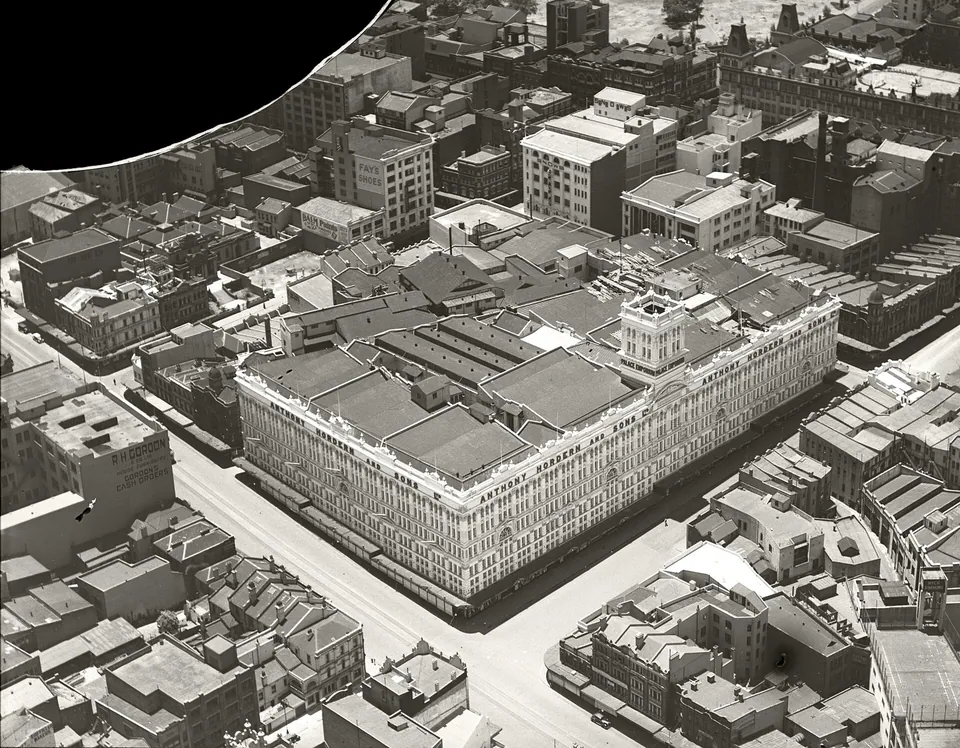
Anthony Hordern’s Palace Emporium
George, Goulburn and Pitt Streets, Brickfield Hill, Sydney
Albert Bond. 1903 to 1905; sixth storey added 1914 to 1915. Victorian and Federation.
- Size
- Frontages of 485 feet to Goulburn Street, 228 feet to George Street and 250 feet to Pitt Street, on a site of more than three acres, with fifteen acres of floor
- Material
- Ten million bricks, a thousand iron columns, hardwood joists and kauri floors, with pressed-steel ceilings made in the firm’s own factories
- Status
- Demolished in 1986. The towers and shopping centre of World Square now stand on the site
On 10 July 1901 fire destroyed Anthony Hordern and Sons’ Palace Emporium in the Haymarket in little more than two hours. Samuel Hordern, third of his family to run the business, chose to rebuild up the slope of Brickfield Hill, on the block where his father had opened a drapery in 1844 and where he himself had been born. In the last weeks of 1903 some eighty shops and houses were pulled down, among them the two stone shops of the 1840s in which the family had first traded. The oak trees that grew on the block were felled and seasoned to make office furniture for the new store, and the oak became its emblem, with the motto “While I live I’ll grow”. Five hundred men dug the foundations 15 to 20 feet deep, and early in 1904 the walls began to rise.
The architect was Albert Bond, long the Horderns’ architect, who had designed their Haymarket store and Samuel Hordern’s country house, Retford Park. The firm built it by day labour under its own building managers, and Samuel Hordern asked that it be as Australian as possible: the ornamental ceilings, panelling, showcases and joinery came from the firm’s own factories and workshops. It took ten million bricks, a thousand iron columns, 60,000 bags of cement and an acre of glass for its 1,430 windows and 35 great show windows, and it cost £300,000. The new Palace Emporium opened for business in September 1905, and on 14 November every department was gathered under its roof.
It filled the southern half of the block, with frontages to George, Goulburn and Pitt Streets. On the slope of the hill it stood five storeys high on Goulburn Street and four on its northern side. Pavilions with rusticated corners marked the corners and the middle of each front, and great half-round windows under pediments lit the fronts at intervals. Over the windows ran deep entablatures, and smaller pediments picked out bays along the way. The building first finished in scrolled gables. In 1914 and 1915 a sixth storey of arched windows took their place, framed with the storey below in a giant order of pilasters, under a frieze lettered “Anthony Hordern and Sons Ltd” and a parapet set with urns. Over the Goulburn Street entrance rose a square tower lettered “Palace Emporium”, with a balustrade and urns at the top.
Inside were fifteen acres of floor. The three lower floors, of nine acres, were open to shoppers, and the two upper floors held reserve stock and the workrooms. Twenty-one hydraulic lifts and broad stairs joined the floors, and goods lifts rose from cartways cut through the building at street level. Payments flew through sixteen miles of brass tube between two hundred cash stations and two cash halls, one tube running 600 feet along Goulburn Street. The steel ceilings were stamped and tinted, and the Saxony carpet was woven in Glasgow with the motto and the oak tree. The soda fountain and marble counters came from the firm’s own marble works, and the refreshment room seated more than 300. More than 1,500 people worked there when it opened, and staff later numbered close to 4,000. The store was advertised as the largest emporium south of the Equator. A second main entrance was made in Pitt Street in the 1930s, and for Queen Elizabeth II’s visit in 1954 the fronts were painted pale blue and hung with flowers.
The store closed in October 1969 and its company passed to Waltons. The New South Wales Institute of Technology, now the University of Technology Sydney, used part of the building, and in 1981 the Heritage Council recommended a permanent conservation order. In 1985 the state government decided that the building would go, and it was demolished in 1986. World Square, with its towers and shopping centre, was completed on the site in 2004, and one of its towers carries the name Hordern.
Sources
- Anthony Hordern and Sons. New Palace Emporium, Sydney. Remarkable record of expansion, Australian Town and Country Journal, 14 November 1906, p. 32 (Trove)
- A big enterprise on Brickfield Hill, Australian Town and Country Journal, 13 January 1904, p. 52 (Trove)
- The end of the Hordern building: ‘Left like a stranded whale on Brickfield Hill’ (Rosanne Robertson), The Canberra Times, 12 May 1985, p. 57 (Trove)
- The Haymarket fire, The Sydney Morning Herald, 11 July 1901, p. 4 (Trove)
- Advertisement: Brickfield Hill only, Haymarket closed, The Sydney Morning Herald, 11 November 1905, p. 1 (Trove)
- Advertisement: Anthony Hordern’s New Palace Emporium … open for business, Goulburn Evening Penny Post, 19 September 1905, p. 3 (Trove)
- Anthony Hordern & Sons, Museums of History NSW
- Anthony Hordern and Sons New Palace Emporium: plans (Albert Bond, architect), State Library of New South Wales, catalogue record
- Nos 569-700 George Street (Anthony Horderns & Sons), 1924-5, State Library of New South Wales
- Anthony Hordern & Sons; Palace Emporium, Dictionary of Sydney
- Albert Bond: biography, Design & Art Australia Online
- Shubra Hall, Wikipedia
- World Square, Wikipedia (citing Tim Dick, ‘Fixing the hole’, Sydney Morning Herald, 7 January 2005)
- Anthony Hordern and Sons, 20 December 1936 (Adastra aerial survey), Royal Australian Historical Society (Flickr, via Wikimedia Commons)
- ‘New Palace Emporium’, Hordern’s department store, Brickfield Hill, c. 1904 (Arthur Ernest Foster), State Library of New South Wales, ON 30/Box 9-16 (via Wikimedia Commons)

